A Unified Peace Theory Peace Assessment
Assessment Statement
Can peace architecture create a tipping point for world peace, and what conditions are required for individual practice, community participation and global mobilisation to become a self-sustaining pattern of peace?
Assessment Overview
David Gershon’s Peace on Earth by 2030 Moonshot is unusually useful for peace science because it treats peace as something that can be deliberately designed, organised and scaled rather than simply hoped for. Its architecture links individual peace practices through the Peace Game, community structures through Peace Zones, cultural mobilisation through PEACE AID, and a wider global goal of engaging 40 million people and establishing Peace Zones across 10,000 cities. [2][3]
This gives the initiative several strengths immediately. It has a clear destination, measurable goals, repeatable activities, distributed leadership and pathways that connect personal transformation with community and global action. PEACE AID adds another important layer because it does not require communities to create entirely new infrastructure. Musicians, choirs, festivals, venues, Rotary clubs and community relationships already exist. PEACE AID attempts to connect these existing resources around peace.
The central finding of this assessment is that peace architecture can create conditions favourable to a tipping point, but scale alone is unlikely to be enough. What appears equally important is the degree of coherence generated between the participants, relationships, communities and institutions inside the architecture.
This suggests a useful distinction between critical mass and critical coherence. Critical mass concerns how many people participate. Critical coherence concerns whether those people become sufficiently connected, aligned, resilient and capable of carrying peace forward that peace begins to reproduce the conditions for more peace.
In this sense, peace architecture provides the structure. Coherence determines whether peace can move through that structure, stabilise within it and continue after the initial activation has passed.
Context
Gershon’s 2025 article Architecting Peace: How Global Cooperation Can Transform Our World argues that lasting peace requires work upstream. Instead of concentrating only on conflicts once they have occurred, the Peace on Earth by 2030 Moonshot seeks to change the underlying conditions from which cooperation or conflict arise. Its approach links shifts in individual consciousness with supportive communities and, eventually, changes in global norms. [2]
The initiative sets unusually concrete goals. Its current materials identify a target of 40 million people consistently practising peace, described as approximately 0.5% of humanity, together with 10,000 cities functioning as Peace Zones. These are presented as thresholds capable of helping tip the global system toward a culture of peace. [4] Peace 2030
PEACE AID provides a practical mobilisation pathway within that wider vision. Rather than organising thousands of new concerts from a central organisation, Community Leaders are encouraged to find events already happening around September 19 and invite musicians, choirs, festivals and venues to dedicate those events to peace. The workshop materials supplied for this assessment show participants already working through Rotary clubs, symphonies, music festivals, performing arts centres, schools, choirs, online performances and community networks in several countries. [3]
The Digital Peace Torch adds a shared action. Participants at different events are invited to light and pass a digital torch, connecting a local musical experience to a wider global peace event. The initiative therefore contains more than a communications campaign. It combines music, synchronised timing, shared intention, symbolic action, local leadership, concrete goals and global identity.
The question is whether those elements can create something more durable than a powerful moment.
That is where coherence becomes central.
Peace Scan
3D — Physical Structure and Participation
The initiative is strongest when peace becomes something people can actually do. A Community Leader is not simply asked to believe in world peace. They identify 10–15 possible music events, choose the strongest opportunities, contact organisers, register confirmed events and return to huddles for support. Musicians dedicate real concerts. Audiences gather in physical places. Peace Zones are intended to operate in actual communities. [3]
This matters because large visions often lose momentum between inspiration and action. Gershon’s model shortens that distance. Someone can begin with a very ordinary question: What music is already happening in my town? That creates an accessible entry point into a much larger goal.
PEACE AID also makes efficient use of existing infrastructure. A choir does not need to become a new peace organisation. A concert venue does not need to abandon its normal function. A local music festival can remain a local music festival while becoming part of PEACE AID. This reduces friction and allows peace activity to travel through networks that already have participants, trust and resources.
Music itself may also support this architecture. Research has long associated shared musical activity with social bonding, and recent work continues to examine how group singing and musical synchrony can strengthen connection and shared experience. [6][7] PubMed Central (PMC) This does not mean that a concert automatically creates peace, but it gives PEACE AID a plausible embodied pathway through which attention, emotion and social experience can become temporarily aligned.
The vulnerability at 3D is sustainability. A concert has an ending. A torch is passed and the audience eventually goes home. The physical architecture therefore becomes stronger if participation creates pathways into continuing relationships, Peace Game practices, Peace Zones or subsequent community action. Without such continuity, a global wave may create significant reach without necessarily creating durable change.
4D — Time, Continuity and the 2030 Trajectory
Gershon’s architecture is explicitly temporal. There is a 2030 destination, interim participation goals, a seven-week PEACE AID action plan, Community Leader huddles, coaching, event registration and defined milestones. [2][3] This creates a sequence rather than relying on spontaneous enthusiasm.
The workshop itself demonstrates how this can work. Participants move from visioning to identifying opportunities, from opportunities to conversations, and from conversations to commitments. They then return to a shared group where progress can be supported. Repetition matters because a peaceful experience that occurs once may remain a memory, while repeated peaceful behaviour can begin to become a pattern.
This aligns closely with the peace mechanics described in Peace As A Science. Peace becomes more durable when the conditions generating it begin to reproduce themselves. A coherent interaction makes another coherent interaction easier; repeated individual practice can strengthen relationships; strengthened relationships can stabilise groups; and sufficiently stable groups can begin influencing wider culture. [1]
The 2030 target, however, also creates pressure. Targets can concentrate action, but they can also encourage a system to value what is easiest to count. Numbers of participants, concerts, cities and events are important measures of reach, yet they do not necessarily show whether peace has become more stable.
The temporal question is therefore not only “How fast is the initiative growing?” but also “What remains six months or several years after participation?”
If PEACE AID events lead to new relationships, recurring peace events, new Peace Game participants or local Peace Zones, then short-term mobilisation is becoming longer-term architecture. If the network repeatedly needs to be recreated through another major campaign, the movement may be achieving activation without yet reaching recursion.
5D — Relationships, Sovereignty and Community
Relationship is one of the clearest strengths of the model. Community Leaders are encouraged to work through people they already know, local organisations they already trust and cultural resources their communities already value. The workshop materials show people bringing different networks into contact rather than waiting for a central organisation to establish each relationship. [3]
This is particularly visible in PEACE AID’s approach to music. A choir in one country does not need to sound like a concert in another. African participants discussed Afrobeat, traditional ceremonies and culturally specific forms of music, while other participants explored symphonies, festivals, blues, school choirs and online performances. [3]
That diversity is not a weakness. It may be one of the architecture’s strongest coherence features.
Coherence does not require uniformity. A global peace system may become stronger when communities can maintain their own identity while participating in a shared pattern. The same peace intention can be expressed through different cultures, musical traditions and community structures.
The workshop also reveals why sovereignty must remain part of the architecture. Concerns were raised about organising musical activity in predominantly Muslim communities in parts of Nigeria and Cameroon. Those concerns should not automatically be treated as barriers or “limiting beliefs” to overcome. They may contain valuable information about culture, safety, legitimacy and local participation.
A coherent global architecture therefore needs both unity and local sovereignty. The global movement can provide the shared purpose while communities determine what peaceful participation looks like in their own setting.
The deeper 5D question is what happens when relationships become difficult. The materials are strong on cooperation, invitation, connection and enthusiasm. They say less about what occurs when there is interpersonal conflict, historical grievance, disagreement about leadership or incompatible definitions of peace.
That matters because peace architecture is most strongly tested when cooperation is not easy.
6D — Meaning, Symbols and the Story of Peace
The Moonshot is consciously attempting to change the story humanity tells about peace. Gershon’s language of “upgrading humanity’s operating system,” the 2030 destination, the Peace Game, Peace Zones, PEACE AID and the Peace Torch all provide shared meanings through which participants can understand their individual action as part of something larger. [2][3]
The Digital Peace Torch is particularly interesting. On the surface it is a simple symbolic act: one person lights a digital torch and passes it to another. Within the wider architecture, however, it links several levels at once. A person connects with another person, an audience participates in a shared ritual, a local event connects with other events, and the current initiative connects symbolically to the earlier First Earth Run.
Music gives the gathering emotional and sensory intensity; the torch gives that experience a shared peace meaning.
This can help transform an audience from spectators into participants. Someone is no longer merely listening to a peace message. They are taking part in a common action and recognising others around them as participants in the same intention.
The risk at 6D is that symbolism can be mistaken for structural change. Someone can have a profound experience at a concert without changing how they handle disagreement the following day. A community can call itself a Peace Zone while remaining fragmented underneath the name.
The strongest architecture therefore allows symbolic coherence to travel downward into ordinary behaviour. The question after PEACE AID is not only whether the torch moved people emotionally, but whether participants became more willing to cooperate, repair relationships, engage across difference or undertake another peace-building action.
Meaning is important. Integration determines whether meaning becomes structure.
7D — System Coherence and the Tipping Point
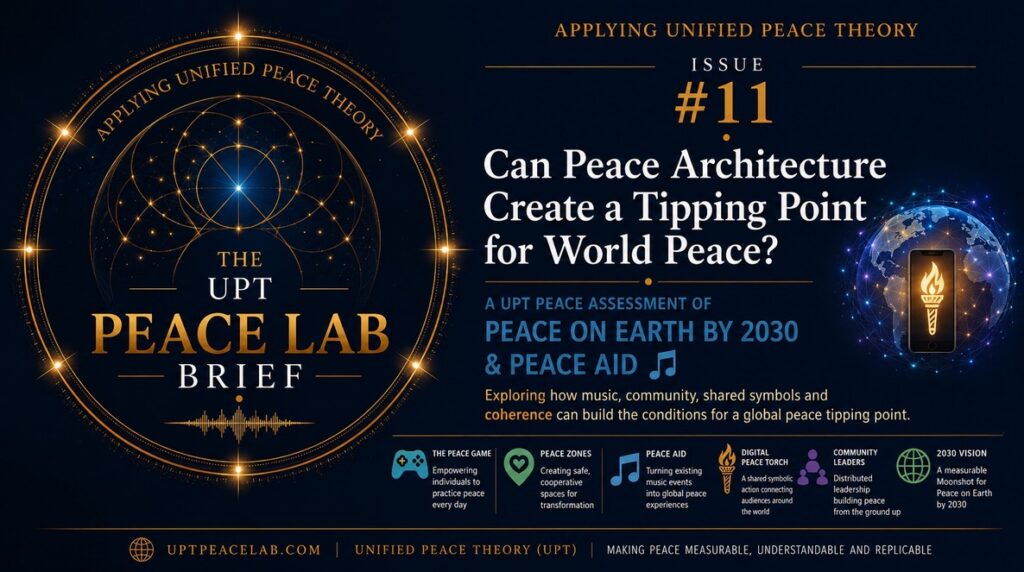
At the whole-system level, Gershon’s model becomes particularly interesting because its different elements are potentially complementary. The Peace Game develops individual practice. Peace Zones provide community structure. PEACE AID activates networks and creates shared experience. The Peace Torch links participation symbolically. Community Leaders distribute agency. The 2030 Moonshot provides a common destination.
If these parts connect, the system can become more than the sum of its programs.
This is where the distinction between critical mass and critical coherence becomes useful.
Research supports the general idea that committed minorities can sometimes trigger changes in social conventions, but there is no universal percentage that guarantees societal transformation. A well-known controlled experiment by Centola and colleagues found a tipping point around 25% for changing an established convention in the specific experimental groups they studied. The authors themselves were studying a bounded social-coordination setting, not a universal threshold for all forms of cultural or political change. [5] Science
More recent modelling reinforces the importance of network and group structure: the size of a committed minority required for change can vary depending on how people interact and how the social system is organised. arXiv This is highly relevant to the 0.5% Moonshot target. The target can function as a clear mobilisation goal, but the presently available evidence does not establish that 0.5% of humanity practising peace will automatically produce a global peace tipping point.
UPT suggests why numbers may tell only part of the story. Peace As A Science proposes that peace over time depends not simply upon participation but upon recursion, coherence density and transmissibility—how much of a system is actually coherent and how effectively that coherence can travel. [1]
This gives us critical coherence.
Imagine 40 million people attending one peace event and then returning to largely unchanged networks. That is enormous critical mass, but its coherence may be shallow.
Now imagine a smaller number whose participation creates lasting relationships between choirs, schools, local governments, Rotary clubs, faith communities, peace organisations and cultural institutions. Those relationships persist, repeat peace activity, repair disagreements and connect with similar networks elsewhere. The number may initially be smaller, but the coherence density and transmissibility may be much greater.
A global tipping point may therefore depend on both how many nodes participate and how strongly peaceful patterns connect those nodes.
This is where Gershon’s architecture shows real potential. PEACE AID is not merely attempting to accumulate individuals. It is connecting existing networks. Peace Zones seek to organise communities. Huddles connect Community Leaders. Music creates synchronised experience. The Torch creates common meaning. Those are all potential coherence mechanisms.
The system question is whether these mechanisms eventually begin reinforcing one another strongly enough that peace activity continues without requiring constant central activation.
That is the point at which peace architecture begins becoming a peace system.
Assessment of the 12 Peace Stabilisers
The twelve Peace Stabilisers provide a useful diagnostic because they examine not simply whether peace activity exists but whether the conditions required to sustain peace are sufficiently present. Peace As A Science identifies Honesty, Open-mindedness, Willingness, Forgiveness, Unity, Discipline, Faith, Responsibility, Love, Wholeness, Joy and Peace as structural stabilisers. Individually they support alignment, relationally they support trust, and collectively they can stabilise culture. [1]
Unity, Willingness, Faith, Love and Joy appear particularly strong. The initiative gives people an optimistic shared destination and asks them to take achievable actions toward it. PEACE AID uses music, creativity and community rather than fear to mobilise participation. The workshop shows considerable willingness, with participants moving quickly from ideas to personal commitments. Unity is pursued without requiring one musical form or cultural identity, which is an important strength. Faith is also embedded strongly in the belief that peace on a planetary scale is possible.
Open-mindedness is generally strong but needs protection as the movement expands. The model invites communities to find their own pathways and uses “yes, and” thinking to encourage possibility. This can help prevent premature defeatism. At the same time, open-mindedness must remain genuinely two-way. Cultural concerns, logistical barriers and disagreement need to be heard as possible information rather than automatically reframed as resistance.
Responsibility is emerging strongly at the local level. Community Leaders are given concrete tasks rather than being encouraged merely to support peace symbolically. They identify opportunities, make contact, register events and return to report progress. This is a significant design strength because agency is distributed rather than retained by a central organisation. The next stage of Responsibility concerns outcomes: participants will increasingly need to know not simply whether they delivered an event but what changed because the event occurred.
Discipline is present in the action architecture but remains a long-term test. Seven-week plans, huddles, coaching and recognition levels create repetition and accountability before the event. The larger question is what holds that discipline after PEACE AID, particularly once the excitement and deadline have passed. A peace system becomes more resilient when peaceful participation moves from campaign behaviour into ordinary community practice.
Honesty is likely to become one of the most important stabilisers as the initiative scales. The goals are bold, and bold goals can generate energy. They also create a need for clear measurement. Numbers of events, Community Leaders and participants should be reported accurately, but deeper outcomes also need to remain visible. A movement can reach large numbers without necessarily changing the underlying conditions of conflict. Honesty therefore requires space for positive findings, disappointing findings, unintended consequences and failed experiments.
Forgiveness appears less developed in the materials presently available. The initiative contains strong activation and cooperation architecture, but there is less explicit information about structured approaches to rupture, grievance, failure, interpersonal harm or reconciliation within Peace Zones and networks. This may become increasingly important as the initiative brings together participants with genuinely different histories and interests. A global peace architecture needs to be capable not only of connecting people who wish to cooperate but of repairing relationships after cooperation breaks down.
Wholeness is promising but not yet assured. Gershon’s overall model attempts something unusually integrated by connecting individual consciousness, community structure and global culture. PEACE AID can strengthen this if its moment of collective activation leads people toward the Peace Game, local Peace Zones and continuing relationships. If the programs remain separate, the architecture may fragment into parallel initiatives. If they feed one another, the model becomes considerably more coherent.
Peace itself is therefore emerging rather than fully stabilised. In UPT, peace is not the absence of activation or disagreement; it is the ability to maintain or return to coherence under pressure. [1] The architecture currently demonstrates considerable capacity to initiate peaceful participation. Its deeper test will be whether communities and networks can preserve relationship, optionality and constructive action when enthusiasm meets conflict, difference or disappointment.
Taken together, the stabilisers suggest a system with strong mobilisation coherence but less developed repair and measurement coherence. That is not unusual for an initiative still scaling. It does, however, identify where the difference between a successful global campaign and a durable peace architecture is most likely to emerge.
Critical Mass and Critical Coherence
The central proposition emerging from the assessment can now be stated more clearly.
Critical mass asks whether enough people are participating for the system to change. Critical coherence asks whether enough of those participants are connected in ways that allow the change to stabilise and spread.
The two are not opposites. They may be complementary.
A peace tipping point could require sufficient numbers to make a new pattern visible and socially credible. At the same time, it could require sufficient coherence density for that pattern to survive after the peak moment of mobilisation.
PEACE AID provides a useful real-world test of this distinction. If thousands of independent concerts add the PEACE AID name but remain otherwise unrelated, the initiative achieves considerable reach. If the same events become connected through the Torch, Community Leaders, continuing relationships, Peace Zones, shared practices and follow-on activity, the initiative begins generating network coherence.
This is closely aligned with the recursive peace mechanics described in Peace As A Science. The key change occurs when peace begins creating conditions that make subsequent peace easier. [1]
A choir joins PEACE AID and meets another local organisation. They later collaborate on another event. That relationship connects to a Peace Zone. The Peace Zone helps resolve a local dispute. People involved develop greater trust and organise another initiative without needing central direction.
At that point, the original event has finished, but its coherence is still moving.
That is recursion in practical form.
Future Outlook
If the initiative continues primarily as a rapidly expanding mobilisation campaign, it is likely to generate substantial symbolic reach, community enthusiasm and a visible global network around peace. PEACE AID’s low barrier to entry and use of existing cultural infrastructure make rapid expansion plausible. Its positive emotional framing may also make participation attractive to people who would not normally enter formal peace-building programs.
The limitation of this trajectory is that participation could remain episodic. Large numbers of concerts and participants might produce an impressive global moment without necessarily changing the relationships, institutions and behavioural patterns that reproduce conflict. In that trajectory, the initiative would still have cultural value, but the evidence for a global tipping point would remain uncertain.
A second trajectory becomes possible if PEACE AID, the Peace Game, Peace Zones and the global Moonshot increasingly operate as one connected system. In that scenario, events become entry points into practice, practice strengthens relationships, relationships create community structures, and community structures connect into wider networks. Feedback from those networks then improves the architecture.
If repair mechanisms, longitudinal measures and local sovereignty strengthen alongside growth, critical mass could increasingly become critical coherence. The initiative would then be doing more than demonstrating public support for peace. It would be building a distributed system capable of generating and carrying peaceful patterns through communities.
The most significant long-term indicator would therefore not be whether the movement reaches one exact numerical threshold. It would be whether peace increasingly continues without needing to be restarted.
UPT Summary
Gershon’s Peace on Earth by 2030 Moonshot and PEACE AID provide a strong real-world example of peace being treated as architecture rather than aspiration. The model has clear goals, distributed leadership, individual practices, community structures, cultural mobilisation and a shared global vision. PEACE AID strengthens the architecture by connecting resources that already exist—musicians, choirs, venues, Rotary networks, festivals and local relationships—rather than requiring entirely new systems to be built.
The assessment finds significant coherence strengths. Unity, Willingness, Faith, Love and Joy are strongly expressed, while Responsibility is supported through concrete Community Leader roles and action plans. Music, shared timing and the Digital Peace Torch create mechanisms through which locally distinct communities can participate in a common peace pattern without sacrificing cultural identity.
The principal vulnerabilities are not in the vision but in the transition from mobilisation to sustained change. Honesty will require measurement of transformation as well as reach. Discipline will be tested after major events finish. Forgiveness and repair architecture appear less explicit and will become increasingly important when real disagreement enters the system. Wholeness depends upon the Peace Game, PEACE AID, Peace Zones and the 2030 Moonshot functioning as parts of one reinforcing system rather than parallel initiatives.
The overall peace assessment is therefore positive but conditional. Peace architecture can plausibly create conditions in which a tipping point becomes more likely, but current evidence does not support any single universal population percentage as sufficient to guarantee world peace. Research on social tipping shows that committed minorities can change norms, while also showing that thresholds depend heavily on network structure, context and interaction. [5]
The most important contribution from a peace-science perspective is therefore the distinction between critical mass and critical coherence. Critical mass creates scale. Critical coherence determines whether peace can stabilise, transmit and survive disruption across that scale. Gershon’s architecture already contains several mechanisms capable of building that coherence. The next question is whether those mechanisms become sufficiently connected and recursive that each peace action makes further peaceful action easier.
If that occurs, the tipping point may not simply be the moment when a particular number of people choose peace. It may be the point at which enough of the global system becomes coherently connected that peace begins helping to reproduce the conditions for more peace.
That is where peace architecture could become self-sustaining.
About the UPT Peace Assessment
A UPT Peace Assessment examines the conditions within a system that strengthen or weaken long-term peace, resilience and coherence. It considers physical conditions, historical trajectory, relationships and sovereignty, competing meanings, whole-system behaviour and the condition of the twelve Peace Stabilisers. The purpose is not to judge an initiative as right or wrong, but to identify where peace is already being supported, where fragmentation may enter, and what trajectory the existing system appears to be creating.
References
[1] Lightworker, M. (2026). Peace As A Science: Towards a Unified Peace Theory. First Edition. In particular: Peace Mechanics, Threshold Emergence, Human Coherence Architecture, the 12 Stabilising Principles, Relational Coherence and Collective Field Strategies.
[2] Gershon, D. (2025). “Architecting Peace: How Global Cooperation Can Transform Our World.” Article supplied for this assessment, 1 June 2025.
[3] PEACE AID. (2026). Community Leader email materials, Artist/Organiser invitation template and PEACE AID Partner Meeting workshop recap supplied for this assessment.
[4] Peace on Earth by 2030. A Peace Moonshot. Initiative materials identify targets of 40 million people practising peace consistently and 10,000 cities functioning as Peace Zones. Peace 2030
[5] Centola, D., Becker, J., Brackbill, D., & Baronchelli, A. (2018). “Experimental Evidence for Tipping Points in Social Convention.” Science, 360(6393), 1116–1119. The study demonstrated a tipping point in controlled social-convention experiments; its specific threshold should not be treated as a universal threshold for social transformation. Science
[6] Tarr, B., Launay, J., & Dunbar, R. I. M. (2014). “Music and Social Bonding: ‘Self–Other’ Merging and Neurohormonal Mechanisms.” Frontiers in Psychology, 5, 1096. The review examines mechanisms linking shared musical activity, synchrony and social bonding. PubMed Central (PMC)
[7] Good, A., et al. (2025). Research comparing biopsychosocial effects of group singing, including evidence relating group singing to mood, social bonding and stress. Scientific Reports. Nature